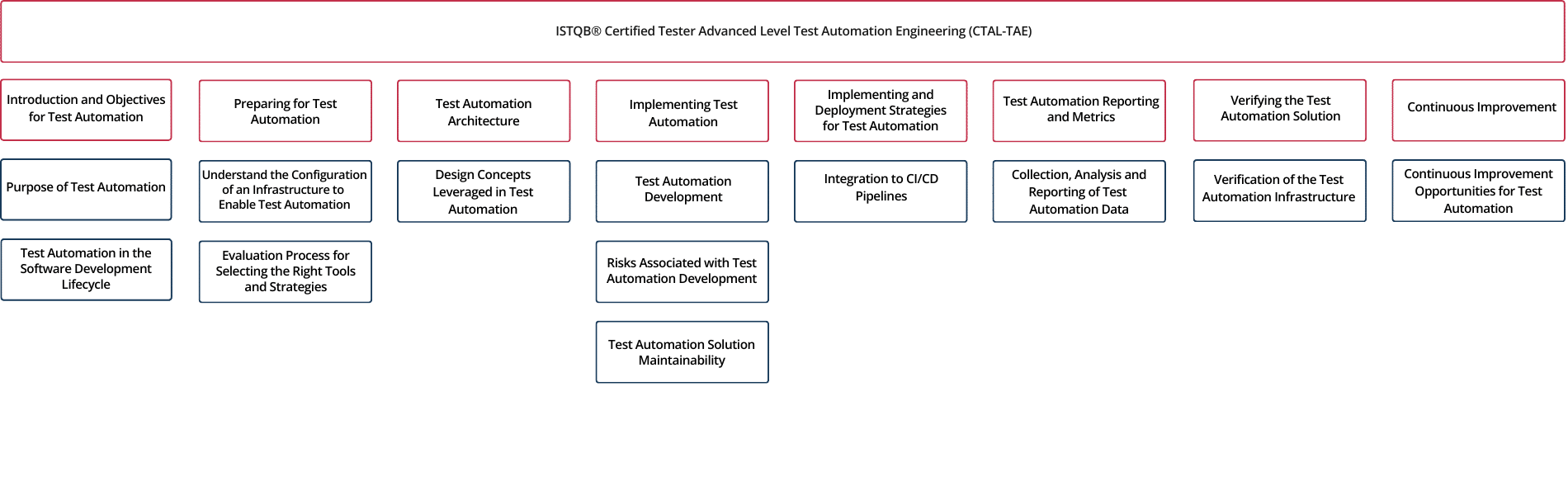
After this training, you will:_x000D_
_x000D_
- understand the purpose of test automation and its application within the software development lifecycle. They will also understand how to configure an infrastructure that enables test automation.
_x000D_
- be skilled in evaluating and selecting the best tools and strategies for test automation. They will also understand the process of planning test automation deployment, including the use of pilot projects.
_x000D_
- gain proficiency in designing and developing modular and scalable test automation solutions.
_x000D_
- be equipped to integrate automated tests within CI/CD pipelines. They will also understand how to verify the test automation infrastructure.
_x000D_
- be able to collect, analyze, and present test automation data and identify areas for continuous improvement in test automation strategies.
_x000D_
An international standard in software testing_x000D_
_x000D_
The International Software Testing Qualification Board (ISTQB) was established in November 2002 with the aim of creating and harmonizing a global certification program for software testing. Today, the ISTQB certification scheme is fully recognized and widely adopted around the world. _x000D_
_x000D_
This three-day accredited course prepares you for the exam of ISTQB Advanced Test Automation Engineering 2.0 and meets the requirements set by ISTQB. _x000D_
_x000D_
You will learn all about test automation development, deployment, and improvement. Besides preparing you for the exam, the course will also provide you with many practical exercises to enhance your skills. Some of the exercises may be based on your own System Under Test.
Who should attend this training?_x000D_
_x000D_
The Test Automation Engineering qualification is aimed at anyone involved in software testing and test automation. _x000D_
_x000D_
Roles of participants in their organization_x000D_
_x000D_
This training is meant for: testers, test analysts, test automation engineers, test consultants, test architects, test managers, and software developers. This qualification is also appropriate for anyone who wants a basic understanding of test automation, such as project managers, quality managers, software development managers, business analysts, IT directors and management consultants. _x000D_
_x000D_
Prior knowledge or training_x000D_
_x000D_
- You possess the ISTQB Foundation Certificate in Software Testing
_x000D_
- You have at least 18 months of experience in testing
_x000D_
- The training does not teach software engineering. However, a test automation engineer is expected to have skills, experience, and expertise in software engineering.
_x000D_
Structure of this training_x000D_
The training lasts three days, spread over a number of weeks in which you will learn all about developing, deploying and improving test automation solutions. The exam consists of 40 multiple-choice questions will take place after the 3-day course._x000D_
_x000D_
With a score of 65% or higher you get the ISTQB Advanced Test Automation Engineering Certificate._x000D_
_x000D_
Course outline_x000D_
_x000D_
Objectives for test automation _x000D_
_x000D_
- Benefits and limitations of test automation
_x000D_
- Test automation within different software development lifecycle model
_x000D_
- Impact of the System Under Test (SUT) architecture on the suitability of test tools
_x000D_
_x000D_
Preparing for Test Automation_x000D_
_x000D_
- Design for SUT testability
_x000D_
- Test automation across different environments
_x000D_
- Assessment of a test automation solution
_x000D_
- Technical considerations and recommendations for test automation
_x000D_
_x000D_
Test automation architecture _x000D_
_x000D_
- Components of a test automation solution
_x000D_
- Approaches to using test automation tools
_x000D_
- Principles and design patterns that can be applied to test automation
_x000D_
_x000D_
Implementing test automation _x000D_
_x000D_
- Plan and deploy a test automation pilot project
_x000D_
- Deployment risks and mitigation strategies
_x000D_
- Maintainability of test automation code
_x000D_
_x000D_
Implementation and deployment strategies_x000D_
_x000D_
- CI/CD pipelines
_x000D_
- Configuration management
_x000D_
_x000D_
Reporting and metrics _x000D_
_x000D_
- Collecting data from an SUT and test automation
_x000D_
- Data analysis to uncover causes of failures
_x000D_
- Test reports and dashboards
_x000D_
_x000D_
Verification of the test automation solution _x000D_
_x000D_
- Examination and verification of test automation components and environment
_x000D_
- Ensuring correct execution of test scripts and suites
_x000D_
- Root cause analysis
_x000D_
- Analysis of the quality of test automation code
_x000D_
_x000D_
Continuous Improvement_x000D_
_x000D_
- Improvement and upgrades to a test automation solution
_x000D_
- Consolidation and streamlining
_x000D_
- Test support and setup needs
_x000D_
_x000D_
Possibilities in-house training_x000D_
_x000D_
ICT Improve provides this training in-house and tailored to your specific situation and needs upon request. For more information, please contact us at +31 (0)40 – 202 1803 or training@ict-improve.nl.
Training information_x000D_
_x000D_
- Location and dates: check the training calendar
_x000D_
- Schedule: 9:15 – 17:00 (three days)
_x000D_
- Includes coffee, tea, lunch and training material
_x000D_
- Three months free e-coaching
_x000D_
_x000D_
For more information, please contact us at +31 (0)40 – 202 1803 or training@ict-improve.nl_x000D_
_x000D_
ICT Improve also offers bespoke in-house training tailored to your specific requirements and needs upon request.
Your trainers are:_x000D_